Mired in the Depths (or Surfaces) of AI’s Ableist Image-making Models
This research project began just as discussions around the use (and misuse) of generative AI were getting quite intense, put mildly, within the academy. So, in thinking about the intricacies of care, disability, chronic illness, and the academy, my mind drifted towards the question of representation: how do emerging AI technologies visualise disability and chronic illness?1 In what ways do these generated images intersect with conceptualisations of care and rights? And how do they impact work and research cultures within the academy?
My method was quite simple, and rather improvised. I wanted to see how AI responded within a set of parameters that were clear and straightforward, simulating – in short – the type of interaction I would expect most users to have when seeking to generate images of disability and chronic illness. First, I put out a query, amongst colleagues and IT specialists, with regards to which was the best image generating software out there. The University of Edinburgh provides access to its own “AI Innovation Platform”, ELM, however the software cannot generate images. Our students at Edinburgh College of Art have access to a range of Adobe products, including Firefly, which was originally released in 2023. Given Adobe’s specialisation in digital media with a great emphasis on the visual, I figured Firefly would provide some interesting ground for experimentation. (Although I do confess that from the get-go, I felt uncomfortable and guilt-ridden thinking about the major ecological implications of my little experiment.)
I tried to imagine the types of conversations my colleagues Gill Haddow and Paula Jacobs were having with disabled and chronically ill colleagues, since they were conducting interviews for our project at the time. Should AI be offered as a tool for interlocutors to visually express what they felt working as researchers, what prompts would they come up with? We are aware that the language around disability and chronic illness is often lacking. It can be overwhelmingly difficult to find a means to convey such complex and challenging experiences, even more in a socio-political context where ableism remains common. Could AI be of help?
A secondary and significant question would be, how do non-disabled individuals imagine disability, and chronic illness in visual terms? That would unavoidably influence the programming of the AI, and the types of images it would be capable of generating. Furthermore, if the AI was trained on pre-existing data sets which are already ripe with stereotypical representations of disability and chronic illness… well, the outcomes would be quite predictable. Most concerningly however, these newly generated images would serve to reinforce already existing stereotypes, creating a type of noxious feedback loop in the public imagination.
I pictured myself within the interviewing scenario (and I did have some insider info since I had seen Gill and Paula’s questions before) and, building on my lived experience, came up with a series of prompts, which I enthusiastically typed into Firefly’s search bar. The first prompt read: “an ableist line manager is showing discriminating attitudes towards a disabled worker”. I figured this would be a general situation that many disabled co-workers could, one can reasonably presume, have experienced at some point in their careers. I used the phrase “discriminating attitudes” to make this general enough for the AI to come up with a range of solutions. However, the AI refused to generate an image. Perhaps the software was triggered by the terms “ableist” and “discriminatory”. I tried alternative prompts, using language that rephrased the problem, as it were:
- an ableist line manager is showing negative attitudes towards a disabled worker
- an ableist line manager is angry at a disabled worker
- an ableist line manager points out a disabled worker during a meeting
- an ableist line manager confronts a disabled worker during a meeting
To no avail. The AI simply couldn’t generate images when the prompt expressed negative attitudes, or when the resulting images could have been regarded as negative (and potentially harmful) representations. There’s a lot of guesswork here, since I don’t have access to any information related to Adobe’s internal programming protocols. Their “Generative AI User Guidelines” however do mention, under the “Be Respectful and Safe” heading, that users should not use Adobe’s generative AI features or services to “Create hateful or highly offensive content that attacks or dehumanizes a group based on race, ethnicity, national origin, religion, serious disease or disability, gender, age, or sexual orientation.” My prompt could have been flagged due to this.
Nevertheless, I thought it would still be interesting to see how AI might picture ableism, a term that denotes an attitude, making it quite difficult to visualise. So, I tried "image of disabled person addressing a group of colleagues which look at them in a condescending manner". AHA! Here's what I got:



Generic images of office workers. Image 1 depicts facial expressions and hand gestures that might be read as dismay on one hand, and confusion on the other. Image 2 by contrast depicts a woman in the process of explaining something to… the camera? While her colleagues busy themselves in the background. Lastly, and most puzzlingly, image 3 shows a man encircled by six people in office attire; they all seem rather content, some are smiling. Two features are shared across these images, firstly the fact that the protagonist is a wheelchair user, secondly that the groups might be described as diverse in terms of ethnicity and gender. Adobe’s coders must have designed the algorithm therefore based on certain criteria for generating "ethnically diverse" images (equivalent to what in the photography world is referred to as stock images). It remains unclear what any of these people are doing. Have they just finished a meeting, given a presentation? Are they posing for a photo campaign to show they welcome disabled people at work? Whatever the case, they seem pleased with themselves.
I tried many different combinations of words however it seemed impossible to get any image that might show friction, or conflict, unease. It was as if the world AI was envisioning simply had no space for negative attitudes or experiences. For instance, "image of disabled person addressing a group of colleagues who do not seem to understand what they are being told" generated this:

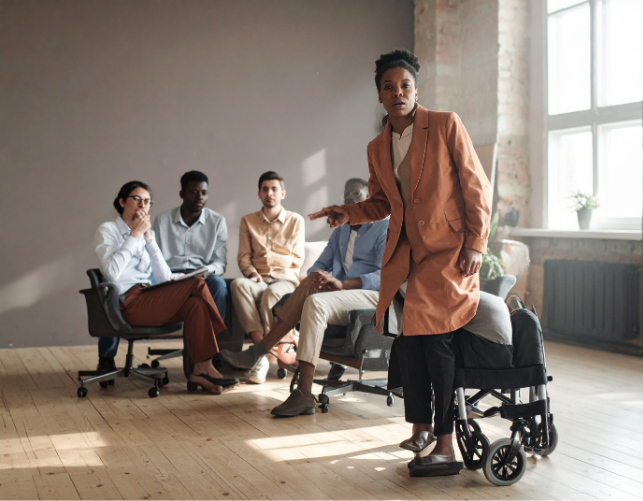
Or "disabled person telling their colleagues that they need to care more about disabled people's needs":

[What is a doctor doing here?]



The settings and configurations of people got quite repetitive, which seems to indicate a small range of options in terms of representing anything related to disability (I ran out of “generative credits” before I could dive deeper into Firefly’s work culture visualisations). The most striking feature amongst all these images remains however the wheelchair. Its ubiquity demonstrates that for the purposes of this generative AI’s understanding, disability = wheelchair use.2
I then tried the illustration function, instead of photo. But the options were just as limited. E.g. "a disabled person is confronted by an ableist line manager"



The first three images looked more like episodes in an office romance to me! The fourth, I couldn’t really decode. The predominance of female-identified wheelchair users was a common feature amongst the imagery generated. Although my focus wasn’t gender specifically, implicit male to female gender dynamics and workplace hierarchies become evident prompting further questions around intersectionality.
At long last, I asked Firefly, "what does ableism look like" and the outcome was very strange to say the least...
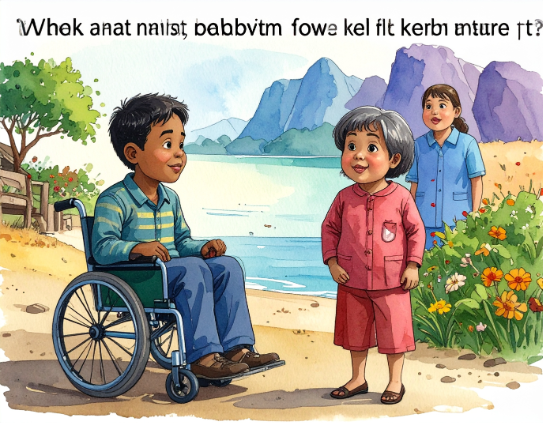
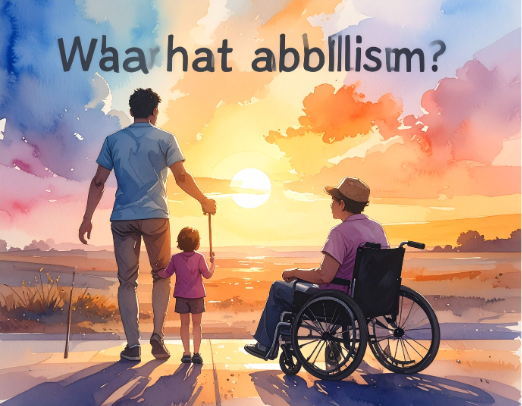
The AI does manage to nominally connect ableism with disability, however what it ultimately generates are cheerful images of distress. These illustrations might seem “happy” and positive on the surface, yet they quickly reveal themselves as oppressively stuck within an ableist paradigm that sees disability in programmatic, top-down (medical) terms. The way in which these images “level” or flatten disability betrays an underlying dismissal of a range of human experience, and its value. Such visualisations are befitting, and inducing, of “crip negativity,” to use J. Logan Smilges’ phrase, whereby the function rather than definition of disability “as a category of being” comes into question. “Whether articulated within medical, social, or political frameworks,” they write, “disability operates as a plasticizing ontology, infusing individuals and populations with varying degrees and qualities of humanness based on their proximity to normativity” (J. Logan Smilges 2023, 9).
Following my brief experiment, I think it’s safe to conclude that when it comes to disability, Firefly is extremely limited in representing anything beyond stereotype. Searching online for further information as to why this is so, I stumbled upon a post on Firefly’s publicly accessible community forum, where a disabled user was raising their concern precisely on this matter:
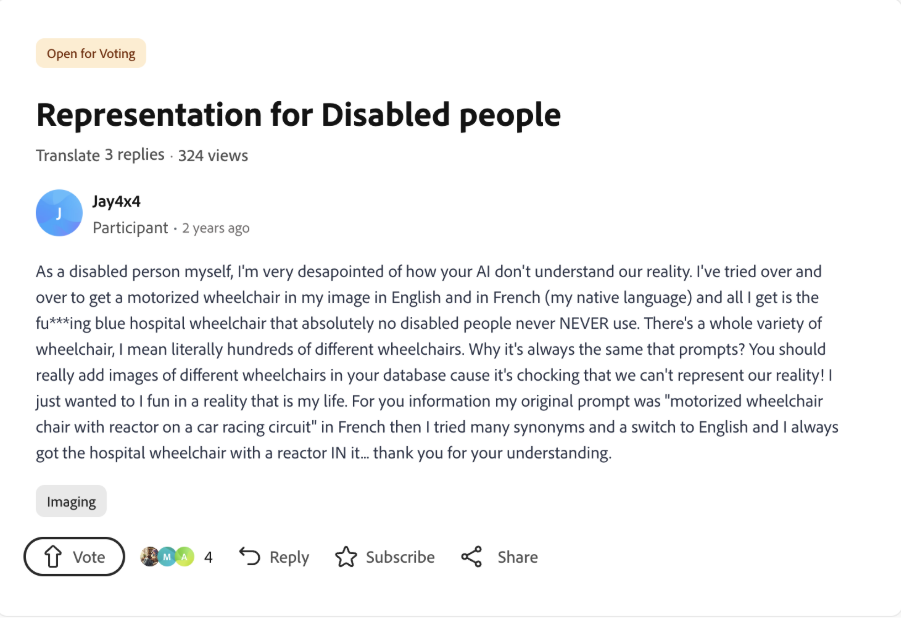
In this instance, the user became frustrated because the AI could only generate one type of image of a wheelchair, quite possibly one influenced by the wheelchair being perceived as the universal symbol for disability. It had no capacity whatsoever to indulge the user’s fantasy. I wonder what they would have felt at learning that Firefly could only image disability as wheelchair-adjacent? Interestingly, the Community Manager responded: “It's really important to us. Keep voicing your feedback. We are listening. ❤️” later adding “I can only imagine how frustrating it is to feel underrepresented because of something that is a part of your identity. Please know your open and honest feedback is being shared directly with the product team. We are working hard to make sure Adobe Firefly is inclusive and representative for everyone, but we need your help. If you continue to see the same results, please also share feedback in the app. Thank you for your help. 🙂” They also included instructions on how to leave said feedback. Which only raises further questions in terms of the onus being on users to report such issues, but also whose labour is being instrumentalised towards “improving” a commercial product.
It turned out that Firefly’s community forum had many more conversations engaging users from around the world, about the flattening of cultural / ethnic / national identities and a reinforcement of bias. Interestingly, while I expected this to apply primarily to regions outside of the West – historically misrepresented in photography and visual culture – it seems as though the AI was equally biased when it came, for instance, to the representation of Europeans (who were, perhaps unsurprisingly, always generically white).
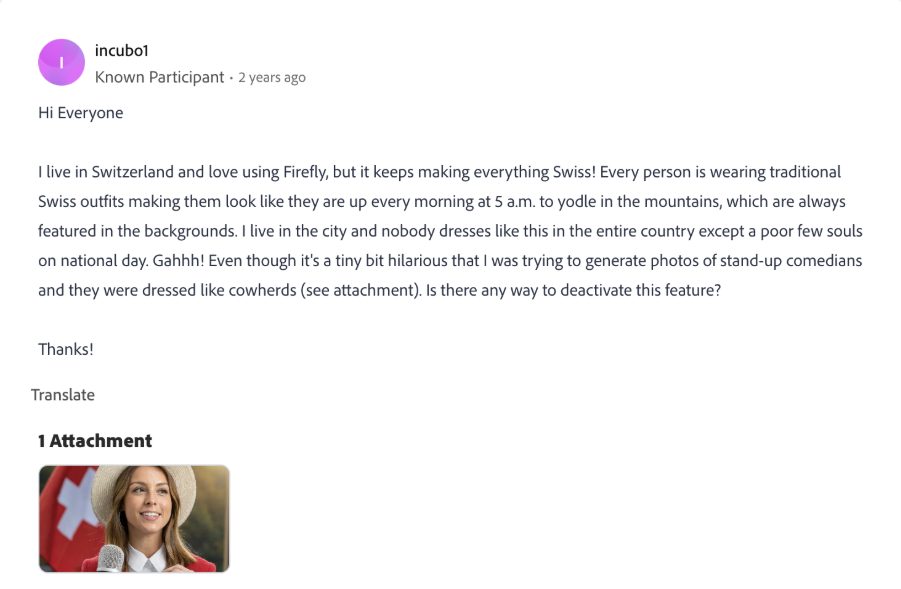
Although largely speculative, this exercise draws attention to the limited (and limiting) representation of disabled and chronically ill identities, and to the difficulty in communicating challenges or struggles in visual terms. The literature on the representation of disability, and less so chronic illness, in mass media, literature, art, and visual culture, is vast, from Paul K. Longmore’s “Screening Stereotypes: Images of Disabled People in Television and Motion Pictures” (1987), Rosemarie Garland-Thomson “Extraordinary Bodies: Figuring Physical Disability in American Culture and Literature” (1997) and Tobin Siebers’ “Disability Aesthetics” (2010), or Beth Haller’s “Representing Disability in an Ableist World” (2010), to Johanna Hedva’s “Sick Woman Theory” (2016).
Interestingly, many of these studies look at text-based representations and narrative forms, drawing upon a shared awareness of the oppressive pervasiveness of normative discourses and how they are visualised across media. As Garland-Thomson put it, "the literary traffic in metaphors often misrepresents or flattens the experience real people have of their own or others’ disabilities” (Garland-Thomson 1997, 10). Lest we forget, AI is primordially a text based medium and while its limitations might be immediately apparent in visual terms, they are less “visible” within its data-derived infrastructural element. Whatever metaphors AI might enable, these are inevitably contained within the normative structures of its making. The technology cannot accommodate imaginative flights of fancy, as seen in the case of user Jay4x4 whose fantasy was terminally disavowed.
Artists have provided powerful responses to such generalised stereotypes, not least by creating alternative and often oppositional images in turn (David Hevey’s “The Creatures Time Forgot: Photography and Disability Imagery” from 1992 remains an important reference). However very little attention has been granted to the proliferation of machine generated imagery, especially in terms of the representation of disability and chronic illness. One recent study looking at automated image generation concluded for instance that “these systems tend to reproduce some problematic biases deeply embedded in our societies by representing disabled people as old, sad and necessarily in a wheelchair”.3
Given the accelerated rate at which image generating AI models are being implemented across many fields, from medicine to mass media, even in the academy, the impact will be substantial. It is therefore essential, and urgent, that we caringly interrogate the ways in which these technologies are built and the uses to which they are put.
Bibliography
Hevey, David. The Creatures Time Forgot Photography and Disability Imagery. Routledge: 1992.
Garland-Thomson, Rosemarie. Extraordinary Bodies: Figuring Physical Disability in American Culture and Literature. Columbia University Press: 1997.
Haller, Beth. Representing Disability in an Ableist World: Essays on Mass Media. The Advocado Press: 2010.
Hedva, Johanna. “Sick Woman Theory.” In How to Tell When We Will Die: On Pain, Disability, and Doom. Hillman Grad Books: 2024.
Longmore, Paul K. “Screening Stereotypes: Images of Disabled People in Television and Motion Pictures.” In Why I Burned My Book and Other Essays on Disability. Temple University Press: 2003.
Maskos, Rebecca. “Ableism technology and (de)construction of stigma: On the adoption of wheelchairs in an ableist society.” University of Sheffield. Accessed March 24, 2026. https://sheffield.ac.uk/ihuman/our-work/marginalised-humans/critical-disability-studies/new-directions-critical-disability-studies/ableism-technology.
Siebers, Tobin Anthony. Disability Aesthetics. University of Michigan Press: 2010.
Smilges, J. Logan. Crip Negativity. The University of Minnesota Press: 2023.
Tevissen, Yannis. “Disability Representations: Finding Biases in Automatic Image Generation.” Presented at AVA Workshop of CVPR 2024. https://doi.org/10.48550/arXiv.2406.14993.