Policy Network
No Policy Is an Island
Most organisations treat policies as if they live in neat little boxes.
HR policies sit with HR. IT policies sit with IT. Estates policies sit with Estates. Health and Safety policies sit with Health and Safety. Equality policies sit somewhere near HR, EDI, or governance, depending on how the organisation has arranged its cupboards. E.g. at UoE HR holds the majority of the policies relating to T&C of employment. Estates holds building related policies, IT hold the computer and digital services.
On paper, this looks tidy.
In reality, it is almost never how policy works.
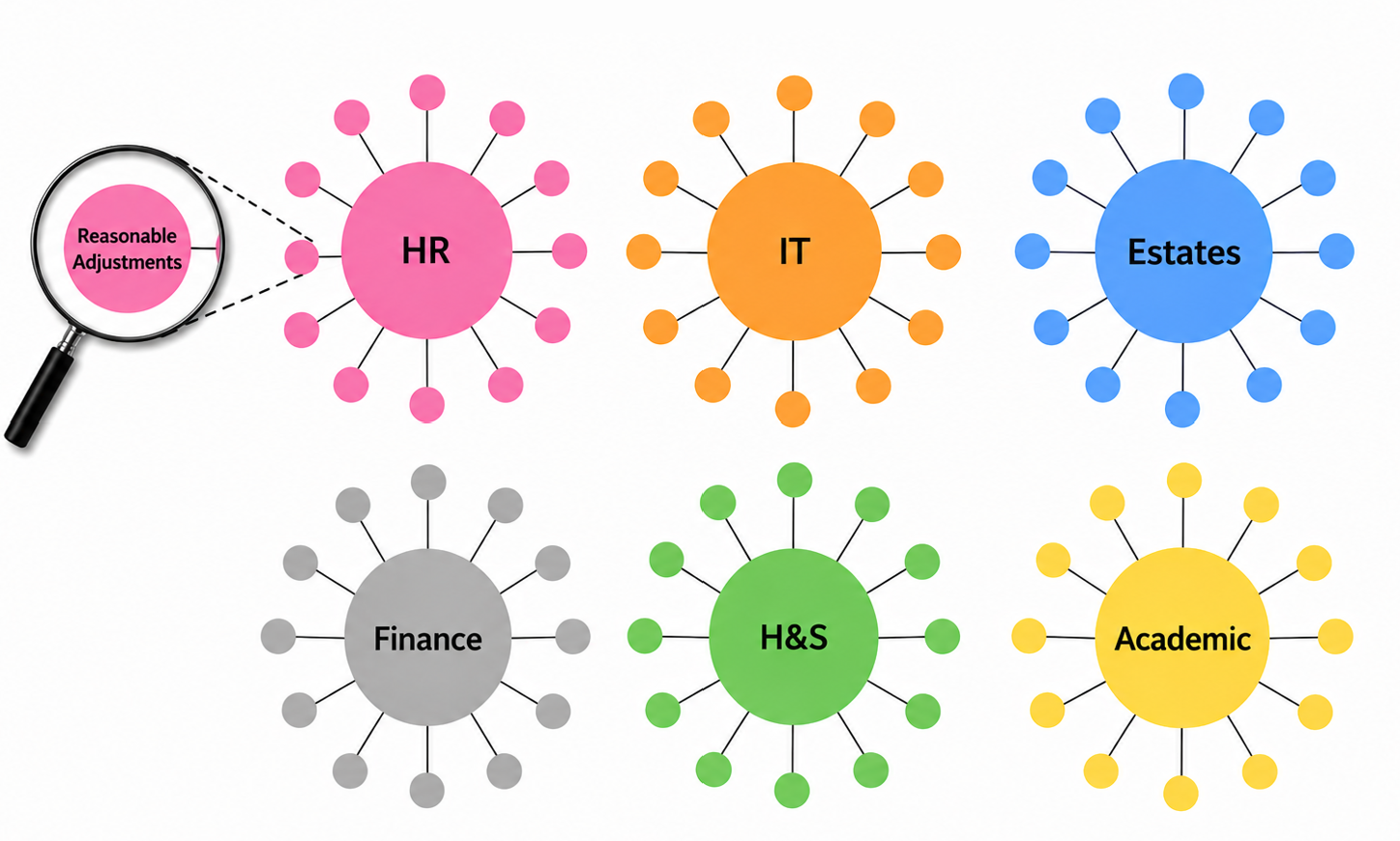
Policies are not islands. They are part of a network. They interact, overlap, depend on each other, and sometimes quietly undermine each other. Changing one policy can affect several others. Implementing one policy may depend on three or four surrounding processes working properly.
The need for connection in a wider sense is easiest to see when we distinguish between two broad types of policy.
Rule-Giving Policies set the rules. They say what the organisation expects, permits, prohibits, or values. A Dignity and Respect Policy, Equality Policy, Health and Safety Policy, or Professional Conduct Policy usually belongs to this family.
Process-Governing Policies explain what happens when those rules need to be applied, investigated, enforced, challenged, or defended. Grievance procedures, disciplinary procedures, capability processes, absence management, complaints processes, appeals processes, and reasonable adjustment processes usually belong here.
A Rule-Giving Policy might say:
“Bullying and harassment are unacceptable.”
But it cannot investigate a complaint, gather evidence, apply sanctions, or support the person affected. For that, the organisation needs Process-Governing Policies. Rules alone do not protect people. Systems do.
But the network goes deeper than that.
Take disability policy. Many organisations treat it as a specialist area: one Disability Policy, one Reasonable Adjustments Policy, perhaps one Accessibility Policy, all sitting neatly in the disability or EDI corner.
That is not enough.
Disabled employees are not only subject to disability policy. They are employees. They are also subject to probation, capability, absence management, disciplinary procedures, grievance processes, workload allocation, IT systems, estates policies, procurement rules, travel policies, flexible working procedures, health and safety systems, and terms and conditions like everybody else. E.g. at UoE, Reasonable Adjustments are governed by the Reasonable Adjustments policy. That should carry over into all T&C type policies, such as Capability policy. However, you will reach page 11 in the Capability policy before disability is even mentioned and even then, the connected to the Reasonable adjustments policy is not clear. And similar disconnect is obvious between the Accessibility policy and the Reasonable adjustments policy. They should be highly intertwined but they are not as one is held by HR and one by Estates.
The difference is that those “ordinary” policies, such as the Capability policy, often affect disabled staff differently.
A capability process involving a disabled employee should not simply ask:
“Can this person perform the role?”
It must also ask:
“Were reasonable adjustments identified?”
“Were they implemented properly?”
“Were they in place long enough to work?”
“Was the role assessed under accessible conditions?”
Otherwise, the organisation may not be measuring capability at all. It may simply be measuring the consequences of inaccessible systems.
The same applies to probation. A disabled employee should not be judged as “not meeting expectations” if the organisation has not first removed the barriers that prevented fair performance.
Absence management also needs to connect properly to disability and reasonable adjustments policy. Disabled staff and chronically ill staff are more likely to encounter absence systems, not because they are less committed, but because bodies are bodies and health conditions are health conditions. If absence processes ignore disability-related absence, adjustment duties, phased returns, flexible working, or disability leave, they can quickly become punitive rather than supportive. At UoE, this is actually quite well done. The Absence Management policy and the Reasonable adjustments policy are heavily interlinked and both establish where their remit beings and ends. The issue at UoE in this aspect is the implementation, not the policy or the lack of connection.
Grievance and disciplinary processes matter too. Disabled staff, especially neurodivergent staff, are more likely to end up in conflict processes when communication differences, distress responses, sensory overload, unclear expectations, or inaccessible management practices are misread as behaviour problems. Those procedures should actively prompt inclusive communication, reasonable adjustments, accessible meetings, support needs, and alternative formats. E.g. at UoE these policies make attempts to cover reasonable adjustments for the process themselves, which is fair for Process Governing Policies. There is, however, a policy gap in addressing the disproportionate involvement of neurodivergent staff. The informal solution section in both policies would be a reasonable place to address this.
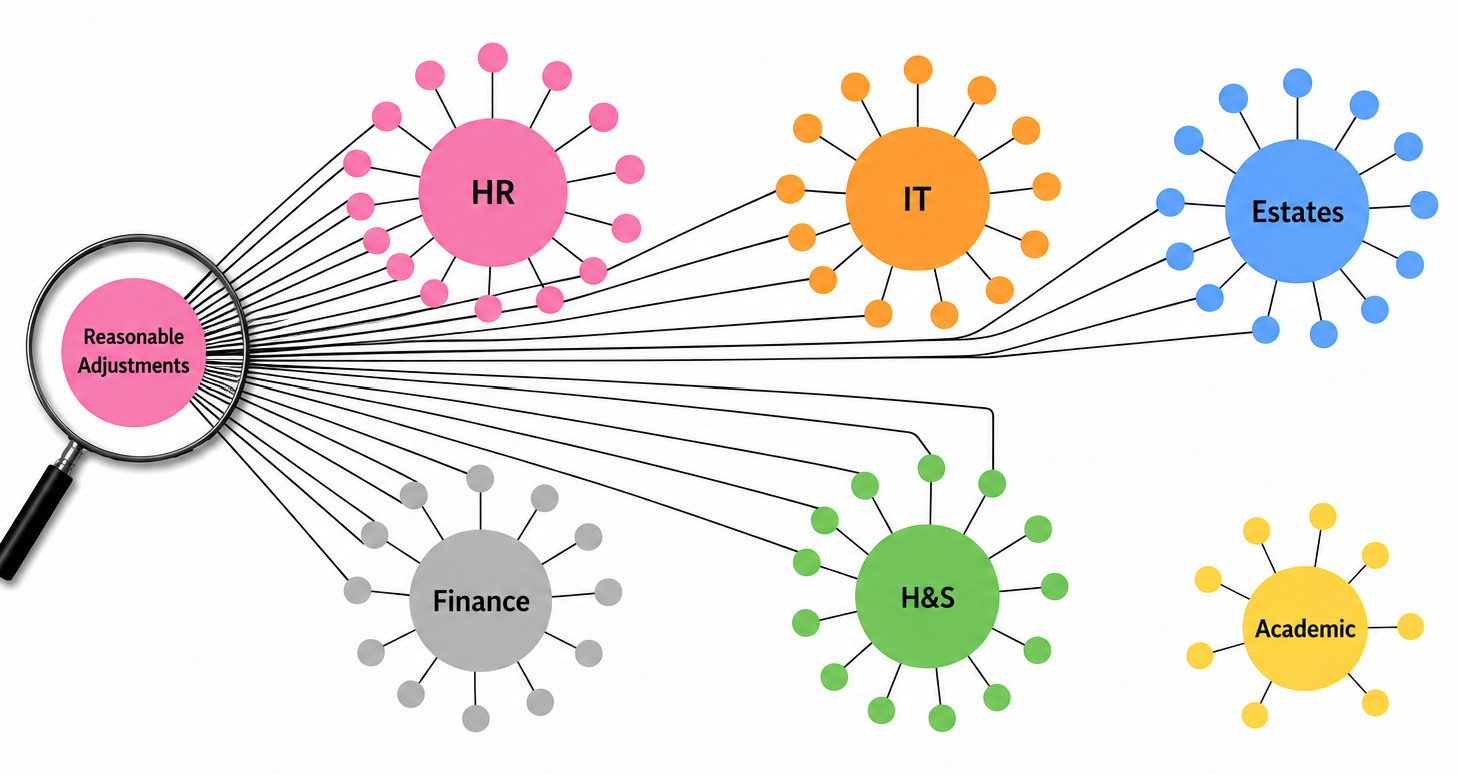
This is where many organisations fail.
They give disabled staff a reasonable adjustment in one corner of the system, then force them to restart the fight from the ground up every time they encounter a different policy.
They get an adjustment for their workstation, but the meeting policy is inaccessible.
They get assistive software, but procurement makes replacement impossible.
They get flexible working agreed locally, but absence management treats fluctuation as failure.
They disclose once to one manager, then have to redisclose to every new process, new department, and new decision-maker.
They win access in one room, then lose it again in the corridor.
That is not inclusion. That is administrative whack-a-mole.
E.g. at UoE that game usually starts when IT policies, Sustainable Travel policy and Accessibility policy clash with the Reasonable Adjustments policy. The staff member gets their reasonable adjustments, but they then cannot be implemented as the other policies have no way of implementing, due to lack of flexibility and lack of Universal Design.
A genuinely inclusive policy system does not leave disability policy sitting in a silo. It connects disability, access, and reasonable adjustments into the wider policy network. Every relevant process should know when and how to cross-reference disability-related duties, inclusive communication, accessibility, and reasonable adjustments.
This matters operationally, not just ethically.
If policies are disconnected, staff improvise. Managers guess. HR firefights. Disabled employees carry the Labour of Inclusion: explaining, chasing, correcting, translating, escalating, and repeatedly making themselves vulnerable simply to access what should already be built into the system.
When policies are connected, implementation becomes easier. Managers know where to look. Processes hand over cleanly. Responsibilities are clearer. Adjustments travel with the employee. Disability is not rediscovered from scratch at every procedural doorway.
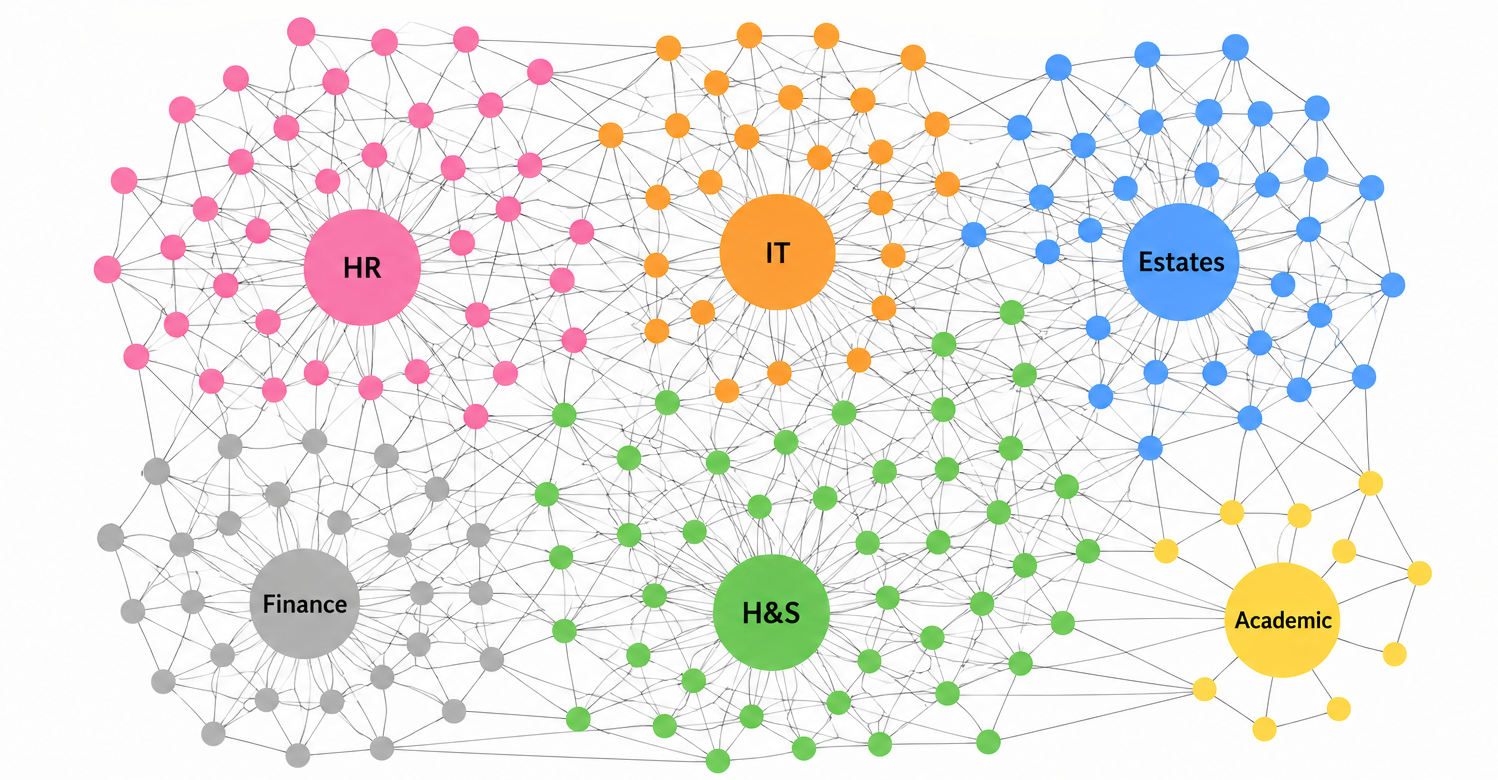
This does not mean every policy has to become a disability policy.
It means every policy should be checked for how it affects disabled people and how it connects to the policies that protect access, dignity, and equity.
A procurement policy should consider accessibility before inaccessible systems are bought.
An estates policy should build access into refurbishment and building decisions.
An IT policy should treat accessibility as a baseline requirement, not an optional extra.
A disciplinary policy should include reasonable adjustments and inclusive communication.
A capability policy should require adjustments before performance is judged.
An absence policy should recognise disability-related absence and fluctuating conditions.
A grievance policy should be accessible enough that people can actually use it.
This is what it means to treat policy as a network rather than a filing cabinet.
No policy is an island.
Every policy sits inside a wider system. Every policy shapes the implementation of others. And for disabled people especially, the difference between a silo and a network is often the difference between a policy that sounds inclusive and a workplace that actually is.